
Brain Health
A new cell atlas brings the brain’s basal ganglia into focus
A new BICAN atlas maps gene activity and cell locations in the basal ganglia, giving researchers a shared resource—not a treatment or patient test.
AI-assisted summary and sourcing. Official and research sources are linked below; this article is informational and is not personal medical advice.
CareNews
Key takeaways
- The atlas connects gene activity with the locations of cells in the basal ganglia.
- The study includes human tissue and two other primate species; it is not a clinical trial.
- The freely available findings support brain research, but do not establish a treatment or diagnostic test.
What did researchers map?
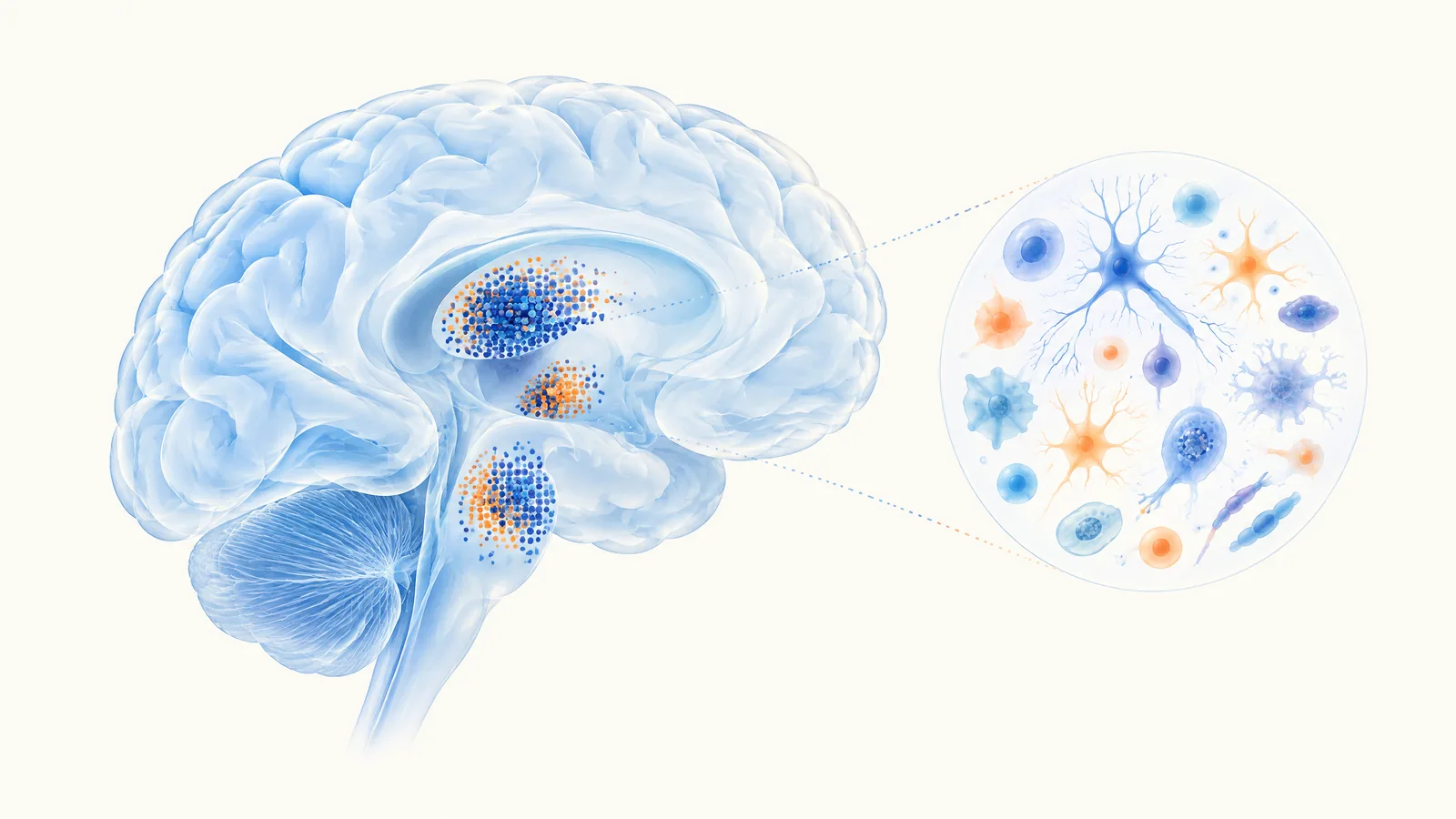
The study in Cell examined the basal ganglia in humans, rhesus macaques and marmosets. Researchers used spatial transcriptomics, a method that maps RNA patterns to show gene activity alongside cell locations.
The work brings together molecular information and the organization of these brain structures. It is a map of cells and their gene activity, not a way to read someone’s thoughts.
Sources for this section: NIH — New basal ganglia cell atlas, Cell — Spatial transcriptomics reveals molecular organization of human and nonhuman primate basal ganglia
Brain tissue, not a patient test
The human research used donated brain tissue studied after death. NIH describes combining sequencing with imaging to place cells in three-dimensional coordinates.
That distinction matters: the atlas describes tissue samples. It does not provide a clinical brain map for an individual living patient or report the results of a treatment trial.
Sources for this section: NIH — New basal ganglia cell atlas, Cell — Spatial transcriptomics reveals molecular organization of human and nonhuman primate basal ganglia
Why this is encouraging research news
The basal ganglia are involved in movement, decision-making and reward, and are implicated in disorders including Parkinson’s and Huntington’s diseases. The atlas offers a reference for research comparing cells in health and disease.
For South Florida adults and families following brain science, the positive development is a freely available research resource—not a new care option.
Sources for this section: NIH — New basal ganglia cell atlas, Cell — Spatial transcriptomics reveals molecular organization of human and nonhuman primate basal ganglia
Sources